Why apys has no smart contract
apys does not have a smart contract of its own. It’s a deliberate choice.
Your money goes from your wallet into audited lending markets on Solana, and it stays there. You can withdraw your position straight from that market. Technically, you don't need apys to exist to do it.
And that's the point.
How a deposit works
You go on apys.co click ‘Earn’. The modal asks you to input your deposit size and pick one of three growth approaches, from most balanced to most aggressive.
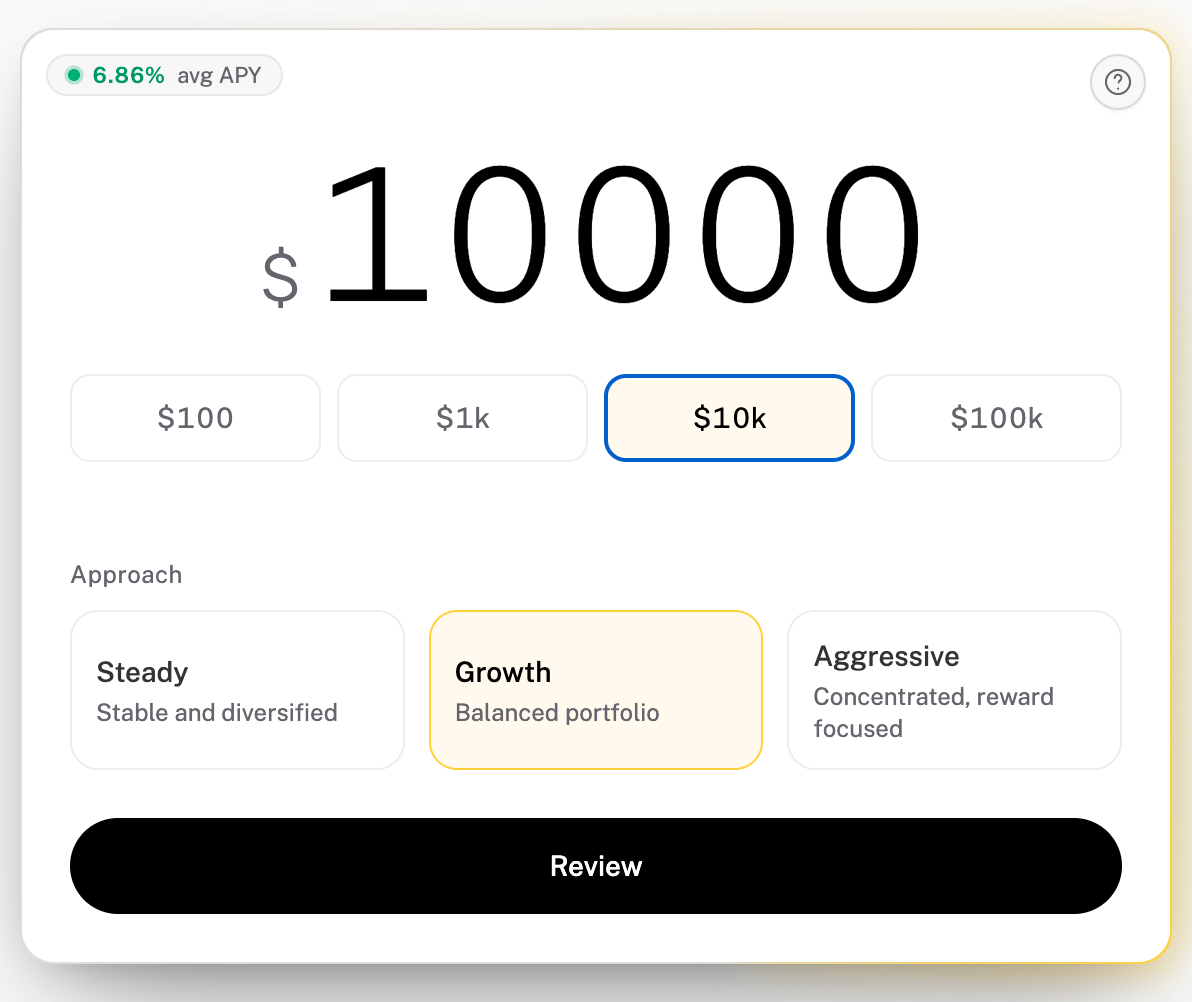
Once you click ‘Review’, a plan is created, showing you where exactly and into which vaults your USDC will be routed. Some deposits require swapping into a different stablecoin to reach a given pool.
We batch those swaps, simulate them, and hand you a batch that has passed simulation. Deposits go through the same check. If one transaction fails in simulation we drop it, execute what can go, and prompt you to retry the dropped leg once it simulates successfully. Nothing is signed that we haven't already simulated against the current chain state.
Why fewer contracts = less risk
Every additional contract in a protocol's stack (a proxy, a bridge relayer, etc) is another piece of code that can hold a bug, an upgrade key, or a privileged role.
Minimizing the contract surface (fewer proxies, fewer cross-contract trust dependencies, no unnecessary upgradeability) shrinks the attack surface and the number of places a single compromised key or logic flaw can drain funds from.
It also plays logically into the nature of apys as a product.
Our core product is the engine that matches your funds to relevant pools. That engine ultimately decides where money should go, but it doesn't need to be the thing that holds it. We route funds directly to audited lending markets—right now that means Kamino, Jupiter Lend and Loopscale (we account for their size, model, risk approach; learn more here). The role of apys is to help figure out what's best for your stablecoins and go from idle to earning in the most simple way.
What this doesn't protect you from
Having no contract removes contract risk. It doesn't remove market risk, and it doesn't remove us from the picture entirely.
If Kamino, Jupiter Lend or Loopscale breaks, your money in that market might be affected, and no architectural choice on our side changes it. That's why a balanced plan is always spread across pools rather than concentrated in the best headline APY. You trade some yield for not having a single point of failure. The most aggressive plan concentrates more, and that's the trade you're choosing when you pick it.
You'll also notice we don't have an audit. An audit reviews code deployed onchain, and we haven't deployed any. The audits that matter here are the ones Kamino, Jupiter Lend and Loopscale have—and having them is a major part of why we route there. The criteria behind every market we use are published here.
To be clear, that isn't the same as there being nothing to review. Our frontend assembles the transactions you sign, and so does the engine that picks the pools. What limits it is that we don't ask you to take our word for any single transaction: every one is simulated against the current chain state before it reaches you, and the plan tells you which markets and which assets before you approve anything. apys never holds standing authority over your funds; nothing moves without a signature from you.
If you have a security question, reach us directly via the ‘Contact’ tab on the homepage and we'll answer it.
The context
It's no secret that DeFi and hacks go hand in hand. According to DefiLlama, as of August 2026, there have been 222 hacks in 2026 totaling $1.27B stolen, with only about $1.9M successfully returned.
The two biggest—Drift and Kelp DAO—account for $295M and $293M respectively. Drift is on Solana, same as the markets we route to. Importantly, we don't route to Drift.
Kelp DAO is worth highlighting because it kicked off a domino effect that left Aave, one of the industry's biggest and most trusted protocols, unable to process users' withdrawals for several days. That felt like a massive shock for the whole industry, prompting it to coordinate to solve the issue.
That cascade was not a hack of Aave's code, but contagion through the stack around it. The more layers between your wallet and the asset, the more ways that stack can seize up. Removing one of those layers is the smallest thing we can do about it, so we did it.
When smart contracts make sense
That is not, of course, to say that smart contracts are bad. On the contrary, they are what makes DeFi possible in the first place.
As apys continues to grow and introduce new features, we might implement smart contracts in the future. If we do, we'll tell you exactly what made us do it, how they're set up and who reviewed them, and how it makes your experience better.
But for now, we've chosen to run things as simply as possible.